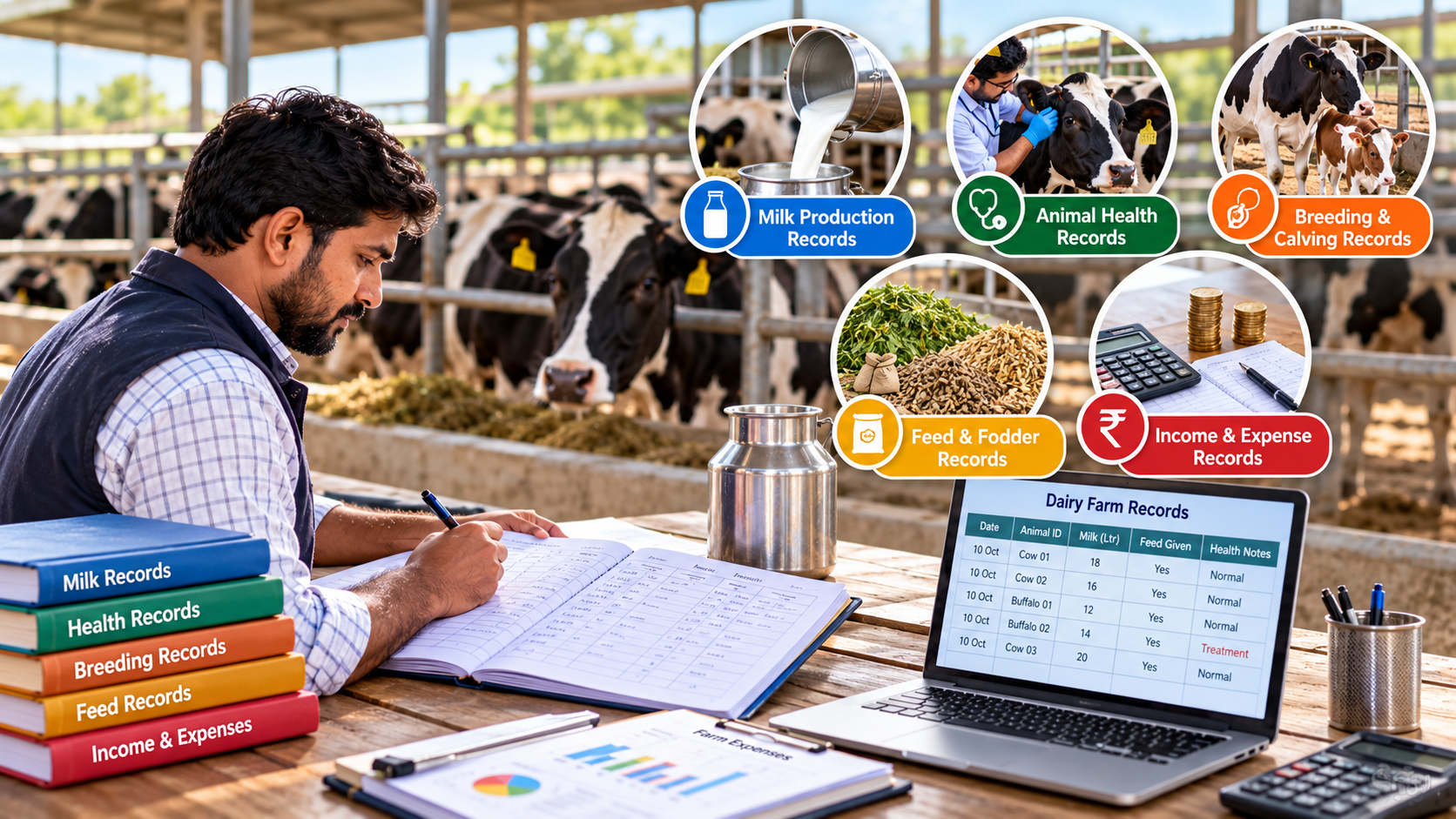
Learn how to maintain dairy farm records for milk production, animal health, breeding, feed consumption, income and expenses to improve farm management and make better business decisions.
How to Maintain Dairy Farm Records: A Practical Guide for Farmers
Introduction
Successful dairy farming requires more than feeding animals and collecting milk. Farmers also need to track milk production, animal health, breeding activities, feed expenses and daily farm operations.
Maintaining proper dairy farm records helps farmers understand how their farm is performing, identify problems early and make better management decisions.
Whether you manage a small dairy unit or a large commercial farm, simple and consistent record keeping can make daily operations more organized.
Why Are Dairy Farm Records Important?
Farm records provide useful information about the performance of individual animals and the overall dairy business.
Proper record keeping helps farmers:
-
Monitor daily milk production.
-
Track feed and fodder expenses.
-
Maintain animal health records.
-
Plan breeding and calving activities.
-
Calculate farm income and expenses.
-
Identify changes in animal performance.
-
Make informed decisions about farm management.
Records are most useful when they are accurate, updated regularly and easy to review.
1. Maintain Daily Milk Production Records
Milk production is one of the most important measurements on a dairy farm.
Farmers should record the milk produced by each animal, wherever practical, rather than maintaining only a single total for the entire herd.
Important details include:
-
Animal identification number.
-
Morning milk quantity.
-
Evening milk quantity.
-
Total daily milk production.
-
Unusual changes in milk yield.
-
Date of recording.
These records can help farmers compare production over time and identify animals that may need additional attention.
If milk production suddenly decreases, the farmer should observe the animal and consult a veterinarian when necessary.
2. Keep Animal Health Records
Animal health records help farmers maintain a history of veterinary care and important health events.
The record may include:
-
Animal identification number.
-
Date of veterinary examination.
-
Symptoms observed.
-
Diagnosis provided by the veterinarian.
-
Treatment and medication details.
-
Vaccination dates.
-
Deworming records, where advised.
-
Follow-up examination dates.
Farmers should follow veterinary guidance for vaccinations, medication and preventive healthcare.
Accurate treatment records are especially useful when several people work on the same farm.
3. Record Breeding and Calving Details
Breeding records help farmers track reproductive activities and plan future herd management.
Important information includes:
-
Date when heat was observed.
-
Heat symptoms.
-
Artificial insemination or service date.
-
Pregnancy examination results.
-
Expected calving date.
-
Actual calving date.
-
Details of the newborn calf.
Maintaining these details can help farmers avoid missed observations and keep track of each animal's reproductive history.
A qualified veterinarian or artificial insemination technician should provide guidance when breeding problems occur.
4. Track Feed and Fodder Consumption
Feed and fodder are important parts of dairy farm expenses. Recording their use helps farmers understand how much feed the farm consumes and plan purchases more effectively.
Farmers can maintain records of:
-
Green fodder availability.
-
Dry fodder stocks.
-
Concentrate feed purchases.
-
Mineral mixture purchases.
-
Daily feed distribution.
-
Feed wastage.
-
Stock remaining in storage.
Feed requirements vary according to an animal's body weight, milk production, age and physiological stage. Feeding plans should therefore be based on appropriate nutritional advice.
Regular stock checks can also help farmers prepare for periods when fresh fodder is less available.
5. Maintain Income and Expense Records
A dairy farm is also a business, so financial records are essential.
Farmers should record income from milk sales and other farm activities separately from expenses.
Common expenses include:
-
Feed and fodder.
-
Veterinary services and medicines.
-
Labour payments.
-
Electricity and water.
-
Equipment maintenance.
-
Transportation.
-
Animal purchases and other major investments.
At the end of each month, farmers can compare total income with total expenses to understand the farm's financial performance.
For a clearer picture, major one-time investments should be recorded separately from routine operating expenses.
6. Maintain Animal Identification Records
Every animal should have a clear and consistent identification method.
Depending on the farm system, identification may use an ear tag or another suitable method.
An animal record can include:
-
Animal ID.
-
Breed or type.
-
Date of birth or estimated age.
-
Purchase date, if applicable.
-
Calving history.
-
Milk production history.
-
Health history.
-
Breeding history.
Consistent identification prevents confusion when multiple animals have similar appearances or names.
7. Use a Simple Daily Record Format
Farmers do not necessarily need expensive software to begin maintaining records.
A notebook, printed register or spreadsheet can be sufficient for a small farm.
A daily record sheet may contain:
| Date | Animal ID | Milk (Litres) | Feed Notes | Health Notes |
|---|---|---|---|---|
| 10 October | Cow 01 | Morning and evening totals | Feed given | Normal or observations |
| 10 October | Buffalo 02 | Morning and evening totals | Feed given | Normal or observations |
The example above is a format only. Farmers should enter their actual observations and measurements.
For larger farms, digital tools can make searching, comparing and reviewing records easier.
8. Review Records Every Week and Month
Recording information is only the first step. Farmers should also review the data regularly.
A weekly review can help identify changes in milk production, feed stocks, animal health and breeding activities.
A monthly review can help answer questions such as:
-
Which animals produced more or less milk?
-
How much was spent on feed?
-
Are veterinary follow-ups pending?
-
Which animals are due for pregnancy checks?
-
How much milk was sold?
-
What were the total income and expenses?
These reviews can help farmers plan the next month's activities and manage resources more effectively.
9. Common Record-Keeping Mistakes to Avoid
Farmers should avoid the following mistakes:
-
Recording information several days late.
-
Mixing records of different animals.
-
Forgetting veterinary treatment dates.
-
Keeping incomplete financial records.
-
Recording milk sales without tracking quantities.
-
Failing to update feed inventory.
-
Maintaining records that are difficult to understand.
-
Sharing important information without confirming its accuracy.
The best record system is one that farm workers can understand and update consistently.
10. Create a Record-Keeping Routine
A simple routine can make record keeping easier.
Every day: Record milk production, feed distribution and unusual animal behaviour.
Every week: Review feed stocks, health observations and upcoming farm activities.
Every month: Calculate income and expenses, compare milk production and review breeding schedules.
Whenever necessary: Update vaccination, treatment, pregnancy examination and calving records.
The routine can be adapted according to the size of the farm and the number of animals.
Conclusion
Proper record keeping is an important part of organized dairy farm management. By tracking milk production, animal health, breeding, feed consumption and financial performance, farmers can understand their operations more clearly and make informed decisions.
Farmers can begin with a simple notebook or spreadsheet and improve the system as the farm grows. The key is to maintain accurate records, update them regularly and use the information to improve daily management.
At AS Dairy, we believe that responsible dairy farming combines healthy animals, thoughtful management and continuous improvement.
AS Dairy — Building a New Era of Farmers.